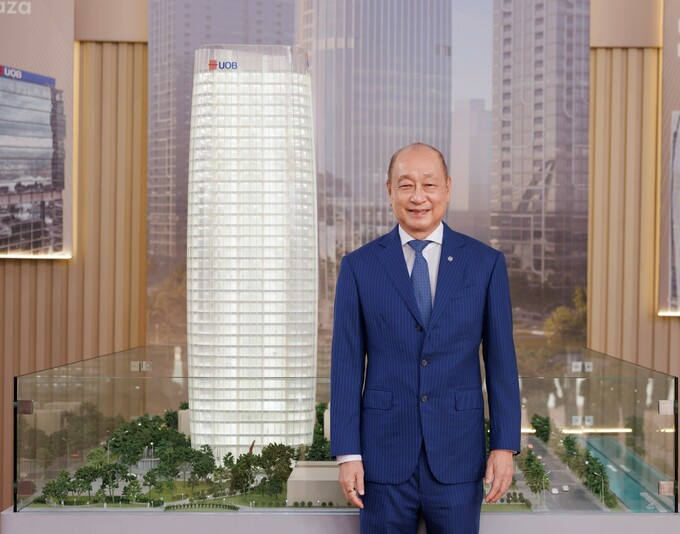
The Singaporean bank officially broke ground on its future Grade A office tower in the Vietnam International Financial Center in HCMC (VIFC-HCMC) on July 1. The project marks the first purpose-built headquarters to be developed and owned by a foreign bank within the financial center.
For Wee Ee Cheong, the groundbreaking of UOB Plaza HCMC represented the continuation of a strategy that began more than three decades ago, when the Singapore-based bank entered Vietnam at a time when relatively few international lenders regarded the country as a priority market.
 |
|
Wee Ee Cheong, Deputy Chairman and CEO of UOB. Photo courtesy of the bank |
A long-term commitment to Vietnam
The bank’s relationship with Vietnam dates back to the early 1990s, when the country was beginning to open its economy and international financial institutions had yet to establish a presence.
Over the past three decades, UOB has expanded its presence in Vietnam in step with the country’s development. From its initial representative office to becoming a wholly owned subsidiary, the bank has steadily strengthened its franchise through branch expansion, capital injections and continued investment in its local operations.
The groundbreaking of UOB Plaza HCMC marks the latest chapter in that journey. For Wee, it reflects the bank’s commitment to growing alongside Vietnam and its confidence in the country’s future.
Today, Vietnam is playing an increasingly important role in regional trade, investment and capital flows. As the country continues to attract foreign direct investment and deepen its integration with global supply chains, Ho Chi Minh City is also advancing its ambition to become an international financial center.
Wee believes Vietnam’s strategic importance will continue to expand as global supply chains diversify and investors seek stable, fast-growing markets in Southeast Asia.
Despite ongoing geopolitical tensions, inflationary pressures, and global economic uncertainty, the bank has continued investing in Vietnam. According to Wee, long-term strategy should not be dictated by short-term market conditions.
“Uncertainty is a given,” he said. “If today is uncertain, we stop; tomorrow is good, we go—that’s impossible. We have to take a long-term view.”
Rather than responding to individual market cycles, the bank focuses on structural trends, including Southeast Asia’s economic integration, demographic advantages, and growing cross-border investment. Within the region, Vietnam stands out because of its young population and openness to foreign investment.
Wee said foreign direct investment benefits Vietnam not only by bringing capital but also by facilitating technology transfer, skills development, and workforce training.
Exposure to international businesses and management practices, he said, is helping prepare Vietnam’s next generation of professionals.
“The young people have the opportunity to learn, to gain exposure and experience. That is the making of a future Vietnam.”
Wee believes the true value of foreign direct investment extends beyond capital. By creating jobs and enabling the transfer of skills, knowledge and technology, it helps strengthen the foundations for long-term growth.
Supporting these investment flows has been a core part of UOB’s commitment to Vietnam. Over the past five years, the bank has facilitated more than S$9 billion (US$7.04 billion) in investments from over 400 companies into the country, contributing to the creation of approximately 60,000 jobs.
 |
|
Artist’s impression of UOB Plaza HCMC. Photo courtesy of the bank |
Connecting ASEAN through a regional model
Supporting cross-border investment requires more than capital. It also depends on the ability to connect businesses, markets and opportunities across the region.
This philosophy underpins UOB’s “One Bank” model. As companies increasingly operate across multiple markets, Wee believes banks need to support customers across borders rather than treat each country as a standalone business.
Instead of operating separate national platforms, the bank has built an integrated regional network across ASEAN supported by centralized technology infrastructure and standardized customer services. Customers in Singapore, Vietnam, Malaysia, or Thailand use similar digital platforms and receive a consistent banking experience.
“We have to be customer-centric,” Wee said. “Connectivity in a business sense means to connect people and businesses to areas which can help them grow. But it also means for customers to have the same look, feel and experience wherever they are banking with UOB.”
The integrated approach has become increasingly relevant as trade and investment flows within ASEAN continue to deepen.
UOB positions itself first as a partner to businesses expanding across the region by facilitating trade, investment and market entry. Beyond that, for individual customers, the bank offers a wider suite of consumer banking services, including cards and wealth management.
“Our philosophy is very simple: one bank,” Wee said. “We help customers build their businesses across ASEAN. If they succeed, naturally they will trust us with more of their financial needs.”
Wee sees ASEAN itself as one of the bank’s most significant long-term opportunities.
With a combined population of around 650 million people, Southeast Asia offers growth potential that few other regions can match. In his view, the region’s competitiveness will depend less on individual markets than on stronger economic integration.
“The competition is outside ASEAN, not within ASEAN,” he said.
He added that political stability, policy consistency, and deeper regional connectivity will remain important in attracting long-term investment.
 |
|
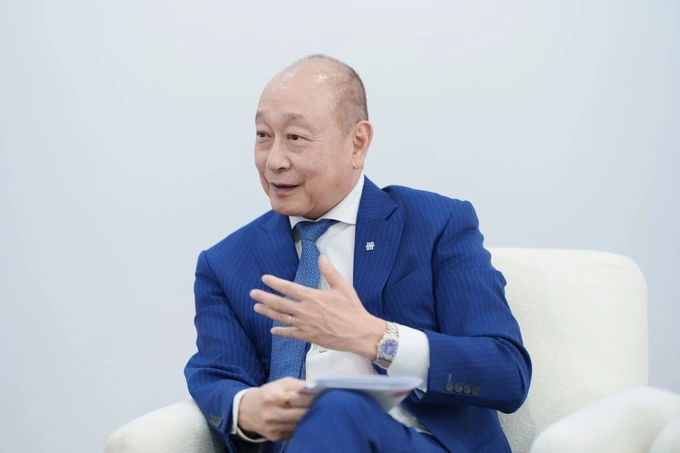
Wee believes Vietnam’s strategic importance will continue to expand as global supply chains diversify and investors seek stable, fast-growing markets in Southeast Asia. Photo courtesy of the bank |
Investing in people and technology
Delivering a regional model at scale requires continued investment in both technology and talent.
As artificial intelligence, automation and digital technologies reshape the banking industry, Wee believes future competitiveness will depend equally on investment in people and technology.
Rather than replacing employees, he said, these technologies can improve productivity, accelerate service delivery, and enhance customer experience. The bank has established a centralized innovation function while continuing to invest in employee training.
“We train our people, and we give them opportunities to experiment,” he said.
He also emphasized the importance of creating an organizational culture that supports employees as technology evolves.
“Management should not inject fear,” he said. “People need confidence to learn new skills and take on new roles.”
Combined with its regional technology platform, these investments enable the bank to introduce products more efficiently, improve operations, and better serve customers operating across multiple ASEAN markets.
“To serve our customers well, we need the right people, the right infrastructure, and the right technology,” Wee said.
Looking ahead, the bank will continue to facilitate cross-border investment projects that create jobs and strengthen economic links between Vietnam and other ASEAN economies.
“We’re not just competing as a bank,” Wee said. “We introduce businesses, investments, and jobs.”
Beyond banking, Wee believes long-term growth also depends on investing in people and communities. In Vietnam, UOB supports initiatives in education, talent development and the arts, including the UOB Painting of the Year competition, alongside its efforts to support economic development through trade and investment.
That approach, he said, has guided the bank’s operations in Vietnam for more than 30 years and will continue to shape its role as both Vietnam and ASEAN develop in the years ahead.
Sourcee.vnexpress.net