Monthong durians, meanwhile, are being sold by farmers at VND46,000-68,000 per kilogram.
Manh, who has 100 six-year-old durian trees in his orchard in southern Dong Nai City, said he has been selling Monthong at VND55,000 per kilogram, the lowest he has ever seen for the variety.
“I am barely making a profit because fertilizer and labor costs have increased this year.”
Hanh, who has a one-hectare durian orchard in the Central Highlands province of Dak Lak, said Monthong prices rarely dip below VND60,000 even during peak harvest seasons.
 |
|
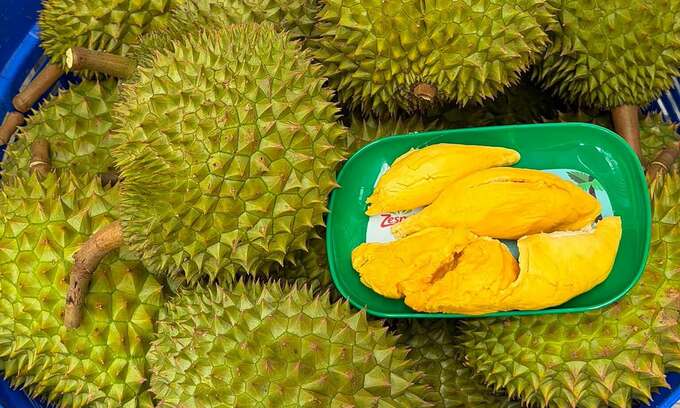
Durians at an orchard in the Mekong Delta city of Can Tho. Photo by Manh Khuong |
Vo Tan Loi, chairman of the Dong Thap Durian Association, said prolonged rainfall in many growing areas has caused 30-40% of the fruits to develop tough and less flavorful flesh.
Grade A (highest quality) fruits that qualify for exports are harder to find this year, and so traders are reluctant to buy in large volumes, he said.
Hoang, a durian trader in the Mekong Delta, said he is buying just a third of the quantity he bought last year.
“If a shipment I sell to exporters is found to have excessive cadmium residues, I will face heavy losses.”
Hoang said the harvest in the Mekong Delta is nearing its end and would soon be followed by the harvest in the southeast.
But that area has also experienced heavy rains lately, and so fruit quality there might also be inconsistent, he added.
Loi said China has been increasingly stringent with its import requirements in recent months.
He Wei, that country’s ambassador to Vietnam, said at the Vietnam–China Trade Forum in Ho Chi Minh City late last month that Chinese consumers are placing greater emphasis on product quality, food safety, and traceability.
If businesses and growing areas implement strict quality control and comply with import standards, the sampling frequency for inspections at border checkpoints could be reduced, speeding up customs clearance, he added.
Sourcee.vnexpress.net